From Bedridden to Independent: Why Post-Stroke Physiotherapy Home Visits are the Key to Recovery in Shah Alam
For families in Shah Alam, the period immediately following hospital discharge is often the most overwhelming. You are relieved to have your parent or spouse back home, but you are suddenly faced with a new challenge: How do you provide professional rehabilitation when simply getting them into a car feels impossible?
This is where the paradigm of recovery is shifting. Instead of forcing a fragile, mobility-impaired patient to travel to a clinic, more families are turning to post-stroke physiotherapy home visits in Shah Alam. It is not just about convenience; for bedridden patients, it is often the deciding factor between stagnation and genuine recovery.
The Hidden Struggle: "The Logistics of Therapy"
If you are a caregiver living in Seksyen 7, Kota Kemuning, or Setia Alam, you know the reality of Shah Alam traffic.
Imagine this scenario: Your father has suffered a stroke and is currently bedridden or wheelchair-bound. To get him to a 45-minute physiotherapy session at a hospital or clinic, you must:
- Lift him from the bed to the wheelchair (risking back injury to yourself)
- Transfer him from the wheelchair to the car (a struggle that can take 20 minutes)
- Navigate the jams on the Federal Highway or Persiaran Mokhtar Dahari
- Find parking near the hospital entrance
- Wait for the appointment
By the time the physiotherapist actually sees the patient, your father is exhausted, anxious, and physically drained. His energy—which should be reserved for neuro-rehabilitation exercises—has been spent on the commute.
Home physiotherapy eliminates this logistical nightmare. By bringing the rehab to your living room, the patient saves 100% of their energy for the therapy itself, leading to faster and more effective results.
Why Home Environment Accelerates Neuro-Rehab
There is a scientific reason why home visits often yield better results for stroke survivors, and it relates to specificity.
Stroke rehabilitation is about rewiring the brain (neuroplasticity). In a clinic, a patient learns to walk on a smooth, flat gym floor. But life isn't a smooth gym floor. Life is navigating the deep carpet in the living room, maneuvering around the coffee table, and stepping over the small ledge into the bathroom.
When a physiotherapist treats a patient at home in Shah Alam, the rehabilitation becomes functional:
- Real-World Training: Instead of practicing on generic stairs, the patient learns to climb their stairs
- Bathroom Safety: The therapist can assess the patient's actual toilet and shower setup, teaching them exactly how to transfer safely in their own space
- Bed Mobility: For bedridden patients, the immediate goal is turning and sitting up. Learning this in their own bed is far more effective than learning it on a hospital plinth
This "context-specific" training builds confidence rapidly because the patient can immediately apply what they learn to their daily life.
What Happens During a "Post-Stroke Physiotherapy Home Visit"?
Many families worry that home therapy is "lesser" than clinic therapy because of a lack of heavy machinery. This is a misconception. Effective neurological rehab relies on the skill of the therapist's hands and the patient's active movement, not expensive robots.
Here is what a typical session looks like for a stroke patient in Shah Alam:
1. The Assessment
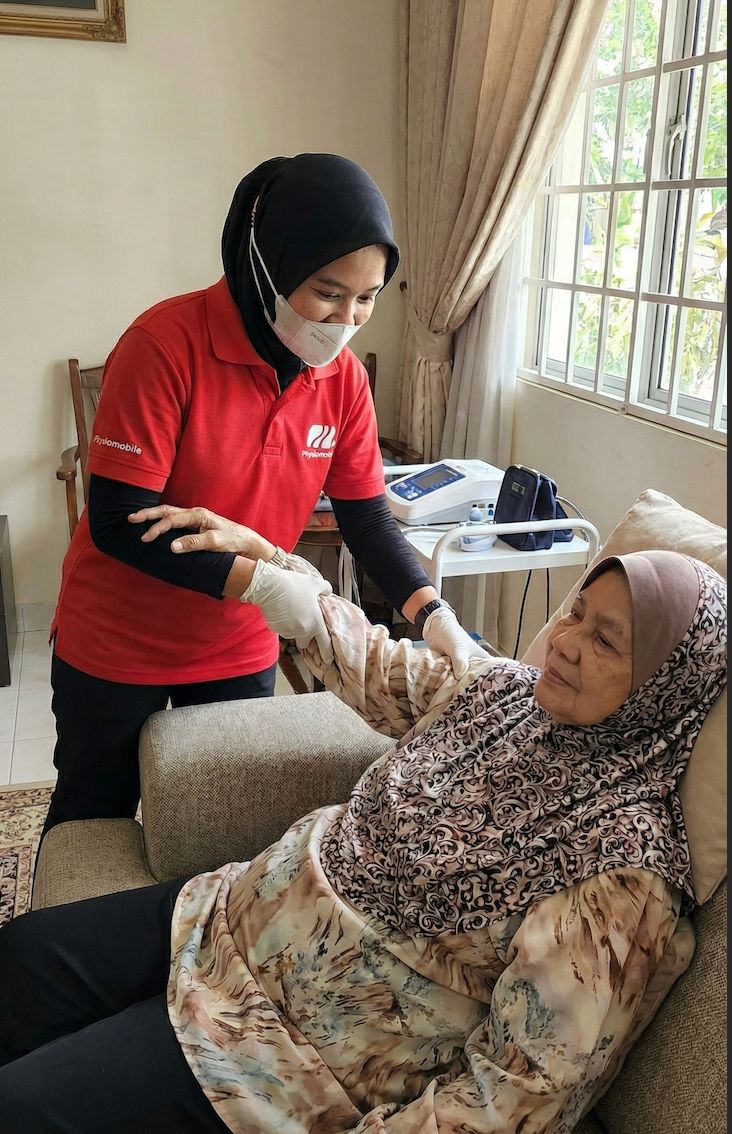
The first visit is a deep dive. The physiotherapist checks muscle tone (spasticity), range of motion, and vital signs. They assess the home environment for fall risks—removing loose rugs or suggesting grab bar installations.
2. Manual Therapy & Neuro-Facilitation
For patients with high muscle stiffness (spasticity), the therapist uses hands-on techniques to relax tight muscles and mobilize stiff joints. They use Proprioceptive Neuromuscular Facilitation (PNF) techniques to stimulate the nerves and remind the brain how to initiate movement.
3. Functional Exercises
- For the Bedridden: The focus is on rolling, bridging (lifting hips), and sitting balance. These are the building blocks of getting out of bed
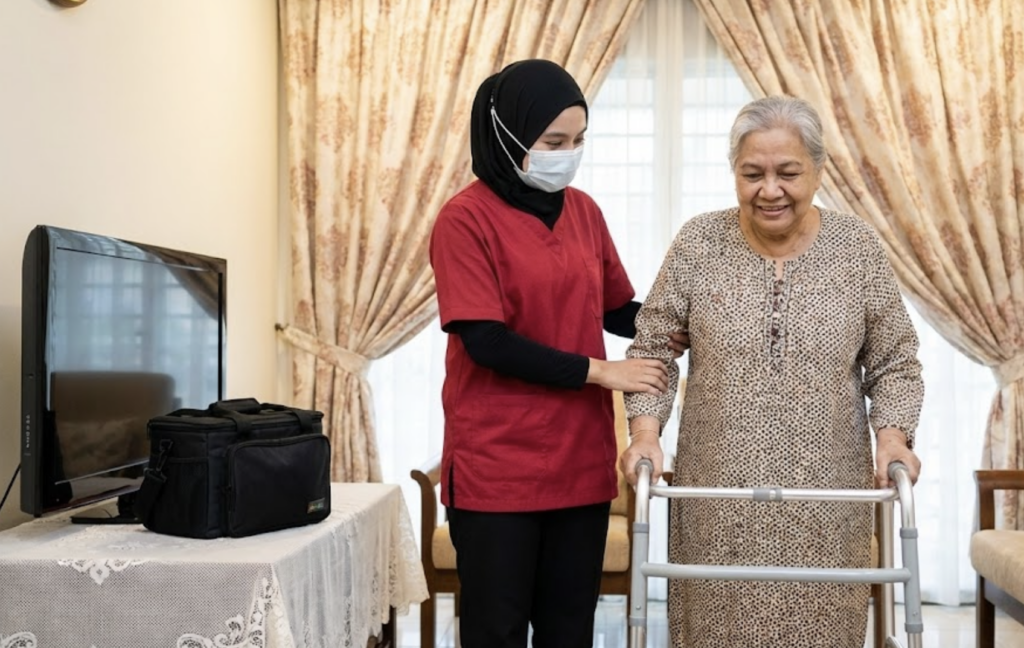
- For the Mobile: Sit-to-stand practice, gait training (walking), and balance exercises
4. Caregiver Education
This is perhaps the most valuable part of the service. The therapist teaches you (the family/maid) how to handle the patient when the therapist isn't there. You learn how to lift without hurting your back and how to position the patient to prevent bedsores.
The Emotional Component: Dignity and Comfort
Stroke recovery is deeply emotional. Many patients feel vulnerable or embarrassed by their condition. Being hoisted into a car and wheeled through a public hospital lobby can feel undignified for someone who was previously the head of the household.
Receiving treatment in the privacy of their home preserves their dignity. They are in their own clothes, in their own air-conditioning, surrounded by familiar faces. This lowers cortisol (stress) levels. Lower stress creates a better chemical environment in the brain for neuroplasticity to occur.
Furthermore, for elderly patients in Malaysia, the concept of "home" is tied to family support. When therapy happens in the living room, the grandchildren can cheer them on, and the spouse is there to hold their hand. This social support is a powerful antidepressant that motivates the patient to push harder.
Choosing the Right Physio in Shah Alam
Not all physiotherapists are equipped for stroke rehab. It requires specific knowledge of neurology, not just sports injuries. When looking for a provider in Shah Alam, ensure you check for:
- AHPC Registration: Ensure the therapist is registered with the Allied Health Professions Council of Malaysia. This guarantees they are a qualified medical professional
- Neurological Experience: Ask specifically if they have experience with post-stroke cases, not just general aches and pains
- Local Availability: You want a provider based in or near Shah Alam (covering areas like Denai Alam, Glenmarie, Subang Bestari, or Alam Impian). A local therapist is more reliable with timing and can accommodate urgent requests better than someone traveling from Kuala Lumpur
The Cost vs. Value Equation
Is home physiotherapy more expensive? On paper, the per-session fee might be slightly higher than a government hospital rate due to travel costs. However, when you factor in:
- Fuel and parking costs
- The cost of an ambulance or specialized transport (if the patient is bedridden)
- The loss of working hours for the family member who has to drive
- The faster rate of recovery due to consistent, high-energy sessions
...home visits often prove to be the more economical and efficient choice in the long run.
Conclusion: Taking the First Step
If you are caring for a loved one recovering from a stroke in Shah Alam, you do not have to do it alone, and you do not have to struggle with the logistics of transport.
Recovery is a marathon, not a sprint. The most important thing you can give a stroke survivor is a consistent, stress-free environment where they can focus entirely on healing. By bringing the rehabilitation to your doorstep, you are giving them the best possible fighting chance to regain their independence.
Whether your loved one is currently bedridden in Seksyen 13 or learning to walk again in Bukit Jelutong, professional help is just a phone call away.
Ready to Start the Recovery Journey at Home?
Contact PhysioMobile HQ today for professional post-stroke physiotherapy home visits in Shah Alam. Our AHPC-registered physiotherapists specialize in neuro-rehabilitation for bedridden patients and stroke survivors.
☎️ Call Us
03-7800-0642